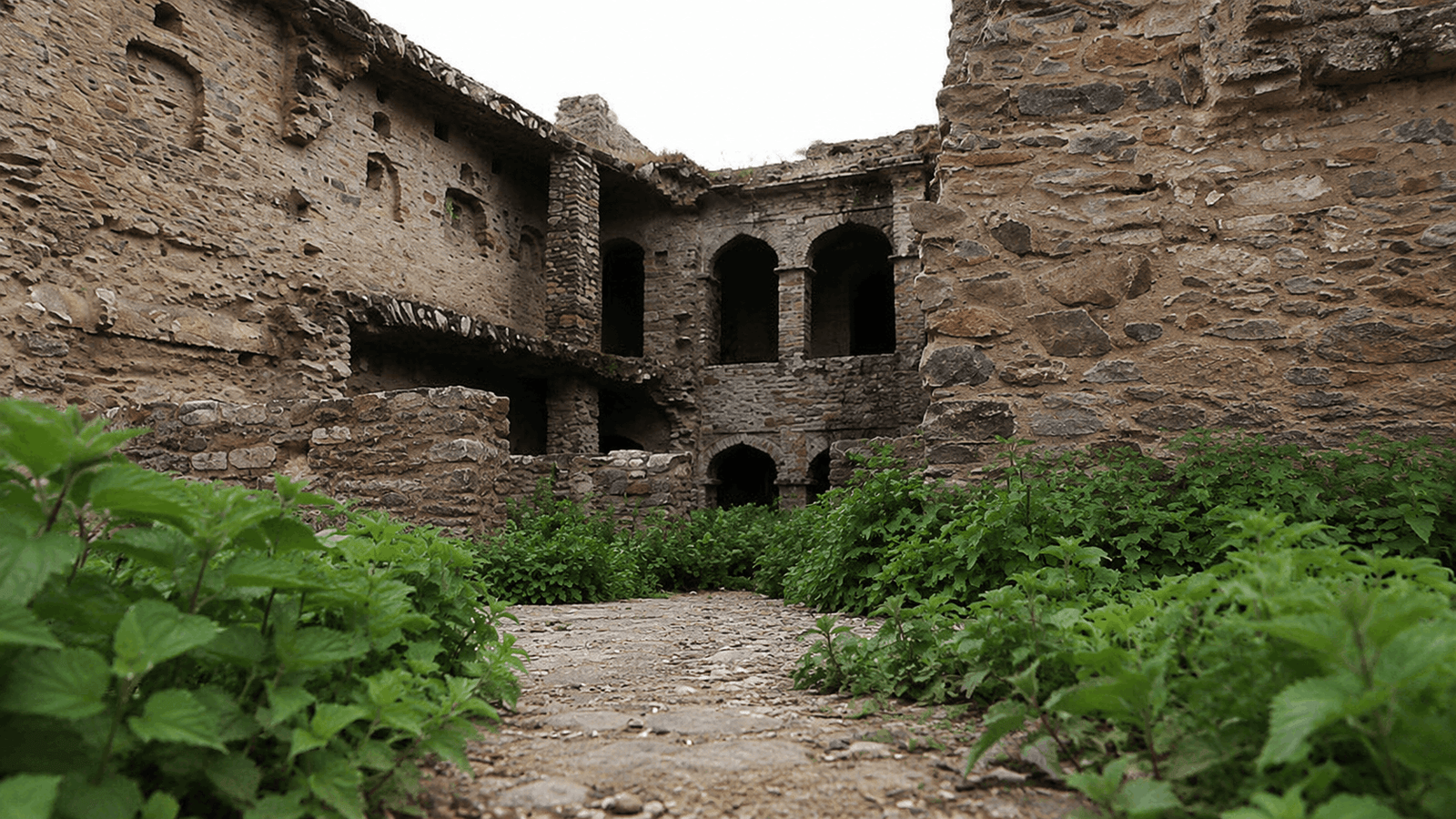
Why the City Feels Structurally Unusual
Most places feel eerie because of stories.
But the strange architecture of Bhangarh Fort creates unease even before the folklore enters your mind.
Something about it looks… wrong.
Not broken in a normal way.
Not ruined like other forts.
But incomplete.
Because if you strip away the curse, the folklore, the reputation—
you’re still left with a city that doesn’t look like it should.
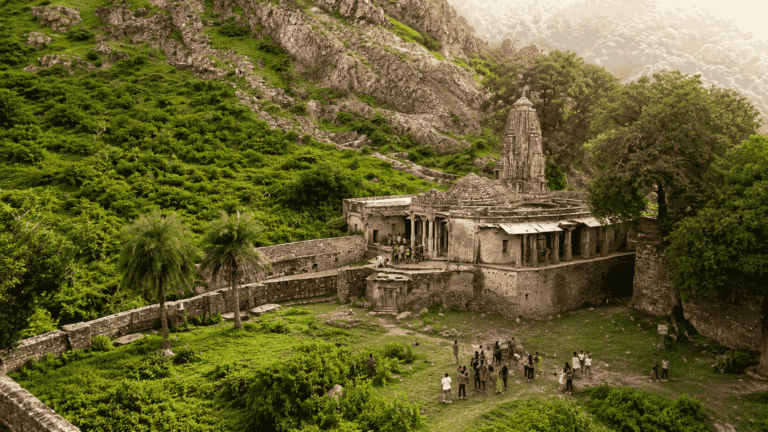
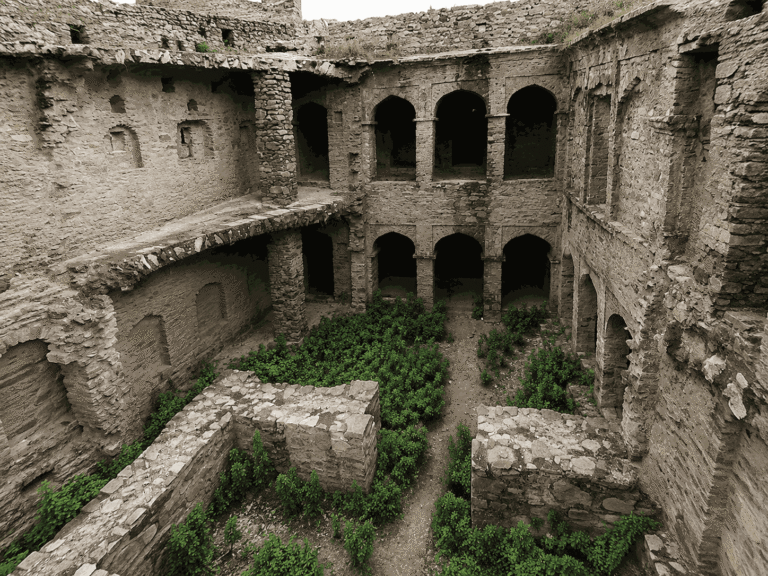
The First Thing You Notice: A City Without Roofs
Walk through Bhangarh and one detail becomes impossible to ignore.
Almost every house is missing its roof.
Not partially damaged.
Not collapsed in chunks.
Just… gone.
Clean, open, exposed structures across the entire settlement.
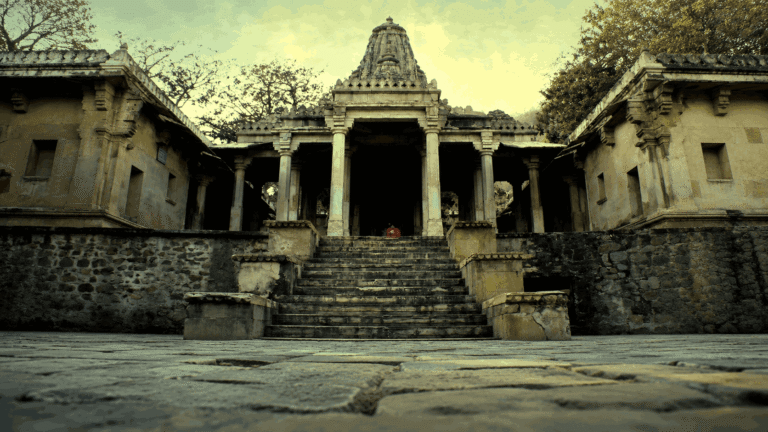
Now look at the temples.
Their stone towers (shikhara) are still standing.
Heavy. Solid. Intact.
That contrast creates the illusion of something selective.
As if:
one part of the city was destroyed
another was protected
Which is exactly why folklore steps in and says:
“The curse removed the roofs.”
But the real explanation is simpler.
Wood Disappears. Stone Remains.
Most residential roofs in medieval towns were not made from solid stone slabs.
They relied on:
wooden beams
lighter structural materials
layered coverings
Over time, wood decays.
Especially in:
exposed climates
abandoned environments
areas without maintenance
So what you’re seeing is not removal.
It’s survival bias.
– Stone survives
– Wood doesn’t
Temples were built with heavier, more permanent materials.
Homes were not.
The “Missing Floors” of the Palace
The Royal Palace is often described as having once been seven stories tall.
Today, only a portion remains.
And what’s strange is this:
You don’t see a massive pile of collapsed debris.
It looks like the upper levels just… disappeared.
That’s where the illusion comes from.
Step-Back Architecture Changes Perspective
The palace is built into the slope of the Aravalli hills.
This creates a step-back design:
lower levels are wider
upper levels are smaller
each level retreats inward
From below, this creates a hollowed, skeletal appearance.
When upper levels collapse:
debris spreads irregularly
structural outlines remain
volume seems reduced, not destroyed
So instead of looking like a collapse, it looks like subtraction.
And the brain reads that as unnatural.
The So-Called Tantrik’s Chhatri: A Strange Placement
High above the fort sits a structure often referred to as the Tantrik’s Chhatri.
Even without knowing the story, something about it feels off.
Because:
it is isolated
it is not integrated into the defensive layout
it does not face outward like a watchtower
Instead, it looks inward.
From that vantage point, much of the settlement including the palace is visible.
At first glance, it does not read like a conventional defensive watchtower.
But in architectural terms, it could function as:
a visual marker
a ceremonial or observational point
a high-ground structure linked to status or presence
The problem is not the structure.
It’s that we’re trying to interpret it through the wrong lens.
The Marketplace That Doesn’t Look Like One
The Jauhari Bazaar is one of the clearest examples of planning in Bhangarh.
A straight road.
Uniform shop structures.
Symmetry.
But look closer.
Many of these shops appear to have:
no visible door fittings
no hinges
no wooden remnants
They feel like open stone compartments.
That creates a strange impression.
Not like shops.
More like cells.
Where Did the Doors Go?
Again, material matters.
Doors were almost certainly made of:
wood
organic materials
Over time, these disappear.
And without visible hinge mechanisms (which may have been simpler or integrated differently), the structure looks incomplete.
What remains is:
the frame
the wall
the empty opening
And the brain reads that as design—when it’s actually loss.
Temple Perfection vs City Roughness
Now compare two things side by side:
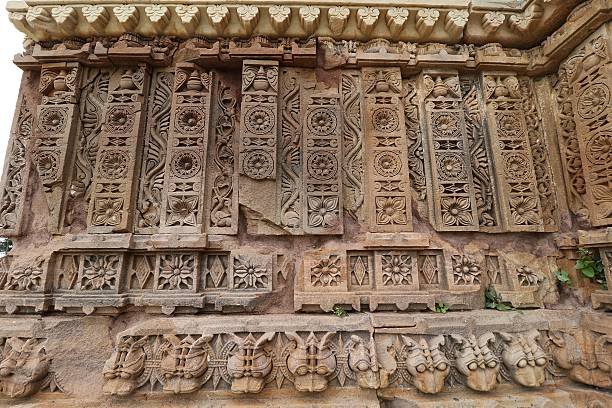
– Gopinath Temple
– Surrounding residential walls
The difference is striking.
The temple:
detailed carvings
symmetrical geometry
polished stone
elevated plinth
The houses:
rougher construction
simpler walls
functional design
It almost feels like two different standards of construction.
Or two different priorities.
This Contrast Is Intentional
Temples were designed to:
last longer
represent divine perfection
withstand time
Residential areas were designed for:
utility
speed of construction
daily living
So when time erodes both, what remains creates imbalance.
One survives beautifully.
The other degrades unevenly.
That contrast feels unnatural.
But it’s actually expected.
Why the Architecture Feels “Wrong”
The strange architecture of Bhangarh Fort does not feel strange because it is impossible. It feels strange because the ruins violate what the brain expects from a built city.
Here’s the key insight.
Nothing in Bhangarh is structurally impossible.
But everything violates expectation.
You expect:
roofs → they’re missing
complete buildings → they’re partial
clear collapse → it looks selective
symmetry → it’s broken
So your brain keeps trying to “fix” the image.
And when it can’t, it labels it as:
strange
mysterious
unnatural
That’s where the feeling comes from.
Not from architecture itself.
But from how incomplete architecture is perceived.
Structure + Ruin = Psychological Effect
Bhangarh is not just ruins.
It is visible structure disrupted by time.
You can still see:
planning
hierarchy
geometry
But it no longer functions.
That creates tension.
Between: What it was and what it is
And that tension is often misinterpreted as something else.
Final Thought
So what makes the strange architecture of Bhangarh Fort feel so unsettling?
Not hidden secrets.
Not supernatural design.
But a combination of:
material decay
hillside construction
selective survival of structures
and the human tendency to expect completeness
What you’re seeing is not a broken city.
It’s a partially preserved one.
And sometimes, what’s left behind feels stranger than what’s completely gone.
Read Next:
- Why Bhangarh Feels Haunted (Reality Explained)
- How Bhangarh Fort Is Built: Layout and Structure
- The Real Story of Bhangarh Fort
For more articles on paranormal phenomena & haunted places, explore the Myth Vs Reality Hub