Layout, Architecture, and City Design Explained
Most people walk into Bhangarh expecting chaos.
Ruins. Broken walls. Random structures scattered across a deserted landscape.
But if you pause for a moment—and actually look—the place reveals something else.
Order.
Not obvious at first. But very much there.
Because Bhangarh was not built as a haunted ruin.
It was built as a planned medieval city.
And once you understand its structure, the entire experience of the place shifts.
A City That Cascades Downward
Bhangarh is not flat.
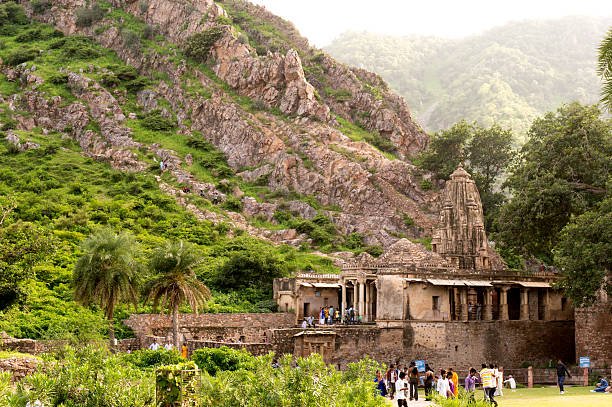
It’s built on sloping terrain at the base of the Aravalli Range, and the entire layout follows that natural gradient.
At the very top:
< the Royal Palace
Below it:
< residential structures and havelis
Further down:
,< the market street (Jauhari Bazaar)
Near the entrance:
,< a cluster of temples
This cascading design is intentional.
It reflects hierarchy:
power at the top
commerce in the middle
public and religious access near entry
Even in ruins, that structure is still readable.
The Five Gates: Controlled Entry Points
Bhangarh was designed as a fortified settlement, not an open town.
It has five main gates, each serving as controlled access points:
Hanuman Gate (primary entrance today)
Lahori Gate
Ajmeri Gate
Phulbari Gate
Delhi Gate
These aren’t just symbolic.
They represent layers of movement control—who enters, from where, and how far they can go.
Beyond the gates, the town is enclosed by massive defensive walls built from Alwar Quartzite, a locally available stone known for durability.
That tells you something immediately:
This was not temporary construction.
It was meant to last.
What You See First: The Temple Zone
As soon as you pass through the main entry, you don’t reach houses.
You reach temples.
This is not accidental.
Several well-preserved temples sit near the entrance, including:
Hanuman Temple
Ganesh Temple
Someshwara Temple
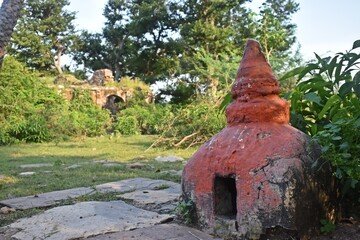
They are built in the Nagara architectural style, common in northern India.
Which means:
raised platforms (jagati)
curving towers (shikhara)
intricate carvings
structured geometry
Even today, these temples are among the most intact structures in Bhangarh.
Which creates an interesting contrast.
The sacred space survived better than the rest of the city.
Moving Forward: Jauhari Bazaar
Walk past the temple zone, and the space opens up.
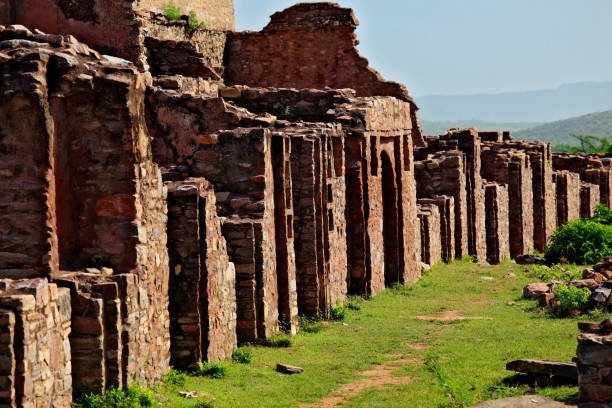
You enter what used to be Jauhari Bazaar—the main marketplace.
It’s a long, straight street lined with:
roofless stone shops
symmetrical structures
repeated architectural units
At one time, this would have been the commercial heart of Bhangarh.
Now, it feels empty.
But the layout is still clear.
Each shop is almost identical in size and structure—designed for uniformity, not randomness.
This is where the “ruins” start revealing planning.
The Havelis: Signs of Social Structure
Beyond the marketplace, you begin to see larger residential structures.
These are the havelis—homes of important residents.
Two notable ones include:
Purohitji Ki Haveli (associated with the royal priest)
Nachan Ki Haveli (often linked to performers or court figures)
These buildings are larger, more complex, and placed away from the commercial center.
Which again reflects hierarchy.
Not everyone lived the same way.
And the city’s design makes that visible.
The Gopinath Temple: Architectural Centerpiece
Among all the temples, one stands out:
< Gopinath Temple
It is built on a high raised plinth (around 14 feet), immediately elevating its importance.
The structure features:
detailed stone carvings
geometric patterns
deity motifs (even though idols are now missing)
What’s striking is this:
While the city around it has collapsed in places, the temple remains structurally intact.
Which tells you something about construction priorities.
Sacred architecture was built to endure.
The Royal Palace: Power at the Top
At the far end of the complex, against the hills, stands the Royal Palace.
This is the highest point in the layout.
From here, you can see:
the entire settlement below
the marketplace
the temples
the outer landscape
Originally, the palace is believed to have had multiple levels—possibly up to seven stories, though only a portion remains today.
Its placement is strategic.
Not just for defense.
For visibility.
Power in medieval cities was not hidden.
It was positioned to overlook everything.
The Role of the Aravalli Hills
The geography of Bhangarh is not incidental.
The Aravalli hills wrap around the settlement on multiple sides, creating:
natural protection
physical enclosure
environmental isolation
This gives the city a kind of contained feeling.
Even today, you don’t feel like you’re passing through.
You feel like you’ve entered something.
And that sensation has nothing to do with ghosts.
It has everything to do with terrain.
Materials and Design Choices
The fort is built primarily using Alwar Quartzite, a locally sourced stone.
It’s durable, practical, and suited for long-term structures.
Beyond materials, the design shows a blend of influences:
Rajput Elements:
elevated structures
defensive planning
hierarchical layout
Mughal Influences:
jharokhas (overhanging balconies)
jaalis (latticed stone screens)
symmetry and proportion
This fusion reflects the broader architectural style of the region at the time.
Bhangarh is not isolated in design—it is part of a larger historical pattern.
The Nagara Style: A Key Detail
The temples within Bhangarh follow the Nagara architectural style, which includes:
Shikhara: a tower that curves inward as it rises
Amalaka: a circular stone disc at the top
Kalash: a finial crowning the structure
Jagati: a raised platform base
These features are not decorative alone.
They define how space is experienced—vertically and visually.
Even in decay, the form remains recognizable.
Why the City Feels Disordered Today
Here’s where things shift.
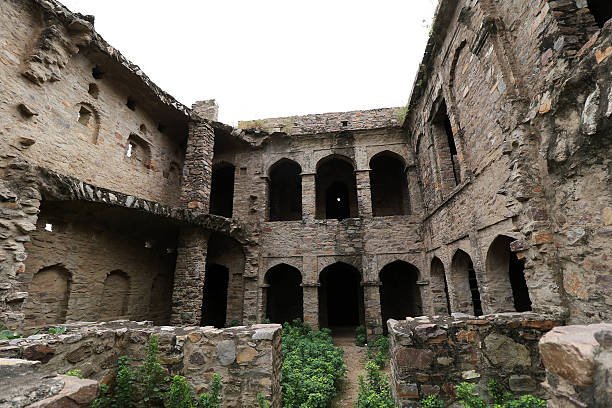
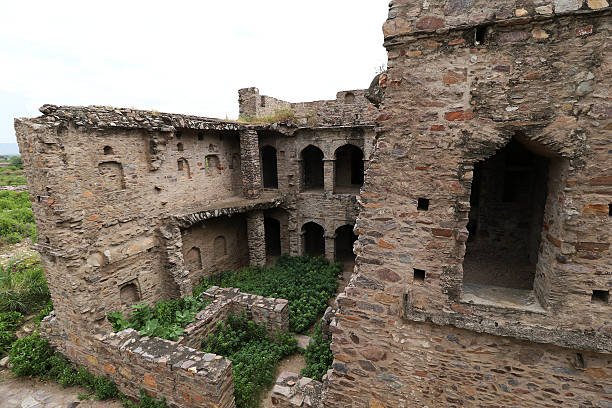
Because what was once structured now appears broken.
Roofs are gone.
Walls are partial.
Spaces are open where they shouldn’t be.
So instead of seeing:
< hierarchy
< order
< function
Visitors see:
< fragmentation
< emptiness
< irregularity
And the brain interprets that as unfamiliar.
Even unsettling.
Structure vs Ruin: The Real Source of the “Mystery”
This is where the architectural reality connects to perception.
Bhangarh feels mysterious not because it lacks structure—
but because the structure is still there, partially visible, but no longer functioning.
You can see what it was meant to be.
But you’re standing in what it has become.
That gap creates tension.
And that tension often gets interpreted as something else entirely.
Final Thought
So how is Bhangarh Fort built?
As a carefully planned medieval city—with defined zones, layered defenses, structured hierarchy, and architectural precision.
What feels chaotic today was once organized.
What feels empty once had purpose.
And what feels mysterious is often just the result of structure meeting time.
Because sometimes, the most powerful part of a place isn’t what was built.
It’s what remains after everything else is gone.
Read Next:
- Why Bhangarh Feels Haunted (Reality Explained)
- The Real Story of Bhangarh Fort: History, Decline, and How It Became Famous
- Is Bhangarh Fort Safe to Visit? What You Should Know Before Going
Or explore the full story behind Bhangarh on the main hub page.