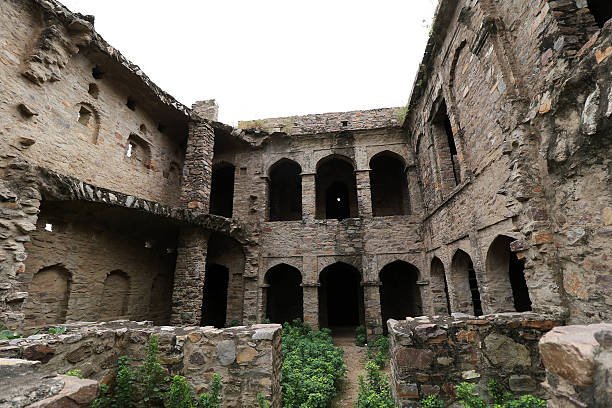
The Mystical Mansion
Some ruins inside Bhangarh feel political.
Some feel religious.
And then there is Nachan Ki Haveli—the Dancers’ Haveli.
Even the name changes the mood.
It suggests movement, music, performance, human presence. Not war. Not kings. Not curses. A different kind of life. One built around culture, entertainment, and the softer side of a fortified town that most people now remember only through its haunted reputation.
That contrast is what makes this place so compelling.
Because today, Nachan Ki Haveli in Bhangarh stands as a partially ruined mansion surrounded by silence, trees, and monkeys. But at one time, it is believed to have been part of the social and cultural life of the settlement.
And that gap—between what it was and what it is now—is exactly where the ghost stories begin.
Where Is Nachan Ki Haveli Inside Bhangarh?
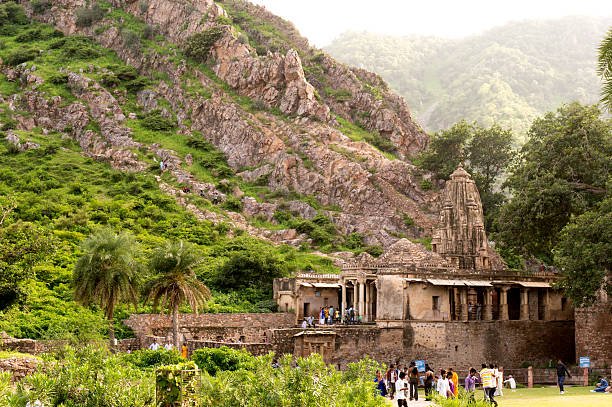
Nachan Ki Haveli lies inside the Bhangarh Fort complex, along the broader path that runs past Jauhari Bazaar, and near other important structures like the Gopinath Temple and Purohitji Ki Haveli.
That location matters.
It places the haveli within the active heart of the old township—not outside it. This was not an isolated pleasure house hidden away from the city. It appears to have belonged to the lived urban fabric of Bhangarh.
In other words, it was part of the town’s functioning life.
Not an afterthought.
What Was Nachan Ki Haveli?
The name itself offers the strongest clue.
Nachan Ki Haveli is locally associated with dancers or performers, and it is widely described as a place where dancing girls may have lived or performed within the old settlement.
That does not mean every detail of its use is historically documented with precision. It means the structure has long been understood, in local memory and visitor interpretation, as a cultural space rather than an ordinary residence.
And that distinction matters.
Because it tells us something larger about Bhangarh:
This was not just a military fort.
It was a living Rajput-era township with:
trade
religion
residential hierarchy
and entertainment
A place with a market, temples, elite houses, and spaces tied to performance and social life.
That broadens the picture considerably.
A Cultural Hub Inside a “Haunted” City
When people think of Bhangarh, they usually jump straight to curse stories and ruins.
But a haveli associated with dancers suggests something else entirely.
Rhythm.
Audience.
Gathering.
Ceremony.
Perhaps even prestige.
If Nachan Ki Haveli really served as a performer’s residence or entertainment hub, then it reflects a side of Bhangarh that gets buried under horror folklore: refinement.
That matters because abandoned places feel more haunting when they once held vivid human life.
A ruined fortress is one thing.
A ruined performance space is something else.
It carries an echo, even when no sound remains.
What Does the Structure Look Like Today?
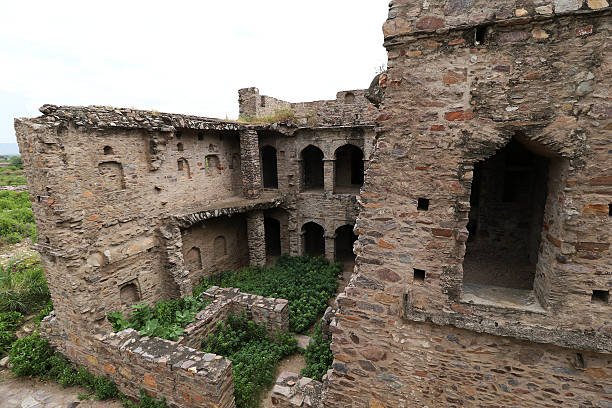
Today, the haveli survives as a three-story ruin.
That alone makes it significant. Even in partial collapse, multi-level structures inside Bhangarh stand out because they reveal how substantial parts of the township once were.
Descriptions of the haveli often emphasize:
a central courtyard layout
upper levels or balconies overlooking that space
remnants that suggest a more ornate or socially visible design than a basic dwelling
This kind of arrangement makes sense for a haveli associated with performance or gathering. A courtyard naturally creates a focal zone. Balconies or projecting openings above it allow for layered viewing, movement, and audience relationship.
Even now, in ruin, the structure still suggests that kind of spatial logic.
You can see that it was meant to hold people, not just walls.
The Balcony Effect
One of the more striking details associated with the Dancers’ Haveli is the mention of balconies overlooking the central open space, sometimes described in almost theatrical terms.
Whether one calls them opera-styled or simply elevated viewing elements, the effect is the same:
This was not a cramped, purely functional house.
It was a place designed with visibility in mind.
That creates a powerful image.
Movement below.
Watching above.
A structured relationship between performer and observer.
And that image lingers, even after the people are gone.
What Surrounds It Now
Today, Nachan Ki Haveli is no longer part of a living cultural center.
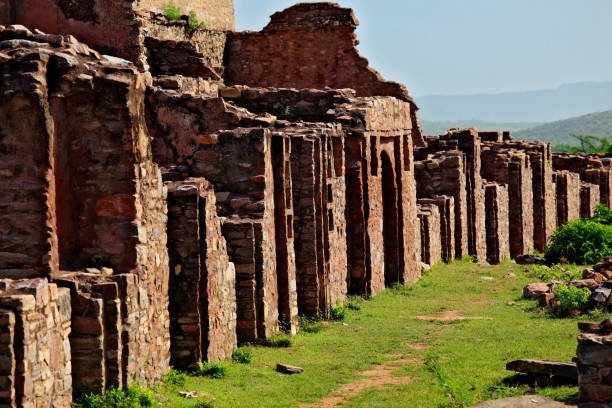
It is part of the ruin zone.
The area around it is often described as:
overgrown or tree-lined
dense in parts
inhabited by large numbers of monkeys
That shift is part of the experience.
A place once associated with performance now sits within a setting shaped by:
vegetation
silence
decay
animal movement
This is where atmosphere starts doing its work.
Not because anything supernatural is proven there. But because contrast is powerful.
Life once filled the structure.
Now non-human life surrounds it.
The brain notices that immediately.
Why This Haveli Became Part of Bhangarh’s Ghost Stories
A site like this almost inevitably attracts folklore.
Why?
Because a ruined mansion tied to dancers fits too easily into the emotional grammar of haunted storytelling.
People already come to Bhangarh expecting:
unfinished history
echoes of the past
signs of something lingering
So a place like Nachan Ki Haveli gets absorbed into that framework.
One of the most repeated beliefs attached to it is the claim that anklet sounds can be heard there at night.
It is an effective image.
Too effective, honestly.
But it needs to be framed correctly:
This belongs to local folklore and ghost storytelling, not verified fact.
There is no confirmed evidence of paranormal activity at the haveli. The anklet story persists because it matches the building’s perceived past and present atmosphere perfectly.
That’s how legends survive.
Why the Anklet Story Feels Convincing
Because it is built from contrast.
A place of dancers.
Now abandoned.
A silent haveli.
A structure with balconies and a courtyard.
A name that already suggests performance.
The mind does the rest.
Once someone hears the story, every small sound becomes easier to reinterpret:
leaves moving
monkeys shifting along stone
birds or animals in surrounding trees
sound carrying strangely through broken architecture
That doesn’t make the experience fake.
It makes it shaped.
And in Bhangarh, shaped experience is everything.
What Nachan Ki Haveli Actually Tells Us About Bhangarh
More than a ghost story, this haveli reveals something important about the city itself.
It shows that Bhangarh once contained:
layered urban life
cultural sophistication
defined social roles
spaces built not just for worship or defense, but for experience
That matters.
Because it pushes back against the flat image of Bhangarh as nothing more than a haunted ruin.
Nachan Ki Haveli suggests a city with rhythm.
And cities with rhythm feel eerie when that rhythm disappears.
What Visitors Experience Today
For most people, the Dancers’ Haveli is visited as part of the daytime walk through Bhangarh Fort.
No active performance space.
No staged interpretation.
Just the remains.
What visitors encounter now is:
architecture in ruin
an atmosphere shaped by memory and suggestion
visible traces of a more socially alive settlement
It is not a site of verified haunting.
It is an atmospheric location that invites projection.
That distinction matters.
Final Thought
So what is Nachan Ki Haveli in Bhangarh?
A three-story ruined mansion inside the old fort complex, associated in local understanding with dancers, performance, and the cultural life of a once-functioning Rajput-era township.
Its ghostly reputation comes later.
From silence.
From decay.
From anklet folklore.
From the imagination attaching itself to a place that seems built for presence and now contains only absence.
That is what makes it linger.
Not because anything has been proven there.
But because some ruins feel less empty than others.
And this is one of them.
Read Next:
- What You Notice First at Bhangarh Fort: A Walk Through the Experience
- Why Bhangarh Feels Haunted (Reality Explained)
- The Strange Architecture of Bhangarh: Why the City Feels Structurally Unusual
- The Real Story of Bhangarh Fort: History, Decline, and How It Became Famous
- The Curse of Bhangarh: How the Legend Began and Why It Endures
Or explore the full story behind Bhangarh on the main hub page.