Why People Say You Can’t Stay After Sunset
The Kiradu temple curse is one of Rajasthan’s most direct legends: stay after sunset, and you may turn to stone.
Out in the desert near Barmer, there’s a place people don’t linger in.
Not because it’s inaccessible.
Not because it’s closed.
But because of a rule no one enforces and almost everyone follows.
Don’t stay after sunset.
The place is Kiradu.
A cluster of ancient temples, carved in stone, standing alone in the Thar Desert.
And attached to them is one of Rajasthan’s most direct and unsettling legends
Stay too long… and you turn to stone.
The Story That Defines the Place
Unlike many haunted locations where the story shifts depending on who you ask, the Kiradu legend is unusually consistent.
It begins with a sage.
He arrives at the settlement with his disciples. Before leaving on a journey, he entrusts one of them—sick and unable to travel, to the care of the villagers.
When he returns, he finds something unexpected.
Not harm. Neglect.
One Person Who Didn’t Turn Away
According to the story, no one in the settlement helped the disciple.
No one except one woman.
Often described as a potter’s wife, she is the only person who shows compassion.
She feeds him. Tends to him. Keeps him alive.
That detail matters.
Because the curse that follows is not random.
It’s selective.
The Curse
Enraged by what he sees, the sage curses the entire settlement.
Not with destruction. With transformation.
Anyone who remains here will turn into stone.
There’s no delay in the story.
No gradual effect. It’s immediate.
And final.
The Final Warning
Before leaving, the sage gives one exception.
The woman who helped his disciple is told to leave.
Immediately.
With one condition: Do not look back.
She leaves. She walks away from the temples, from the settlement, from everything she knows.
And at some point depending on the version she looks back.
Just once. And turns to stone.
Why This Story Stays Intact
Because it’s simple.
And because it follows a structure that repeats across many legends:
– A moral failure (neglect)
– A moment of judgment
– Apunishment that reflects the act
It’s not just a curse. It’s a warning.
The Temples Themselves
Walk into Kiradu today, and the story doesn’t feel exaggerated.
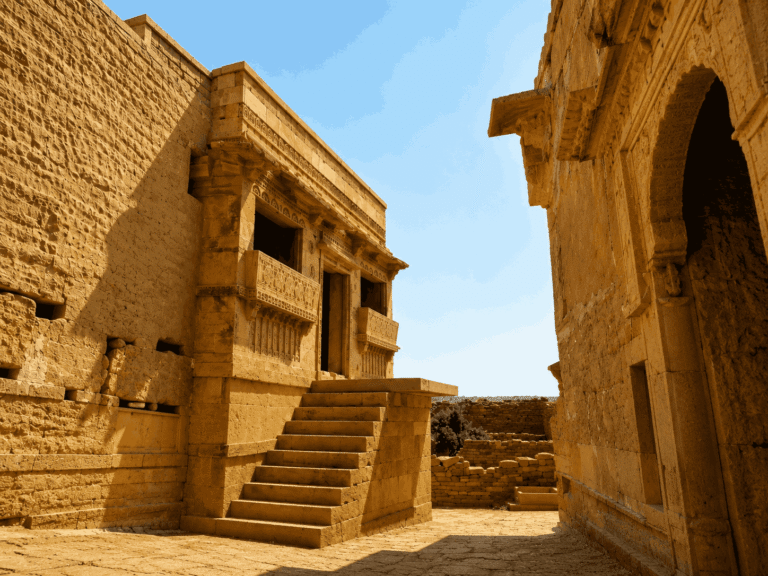
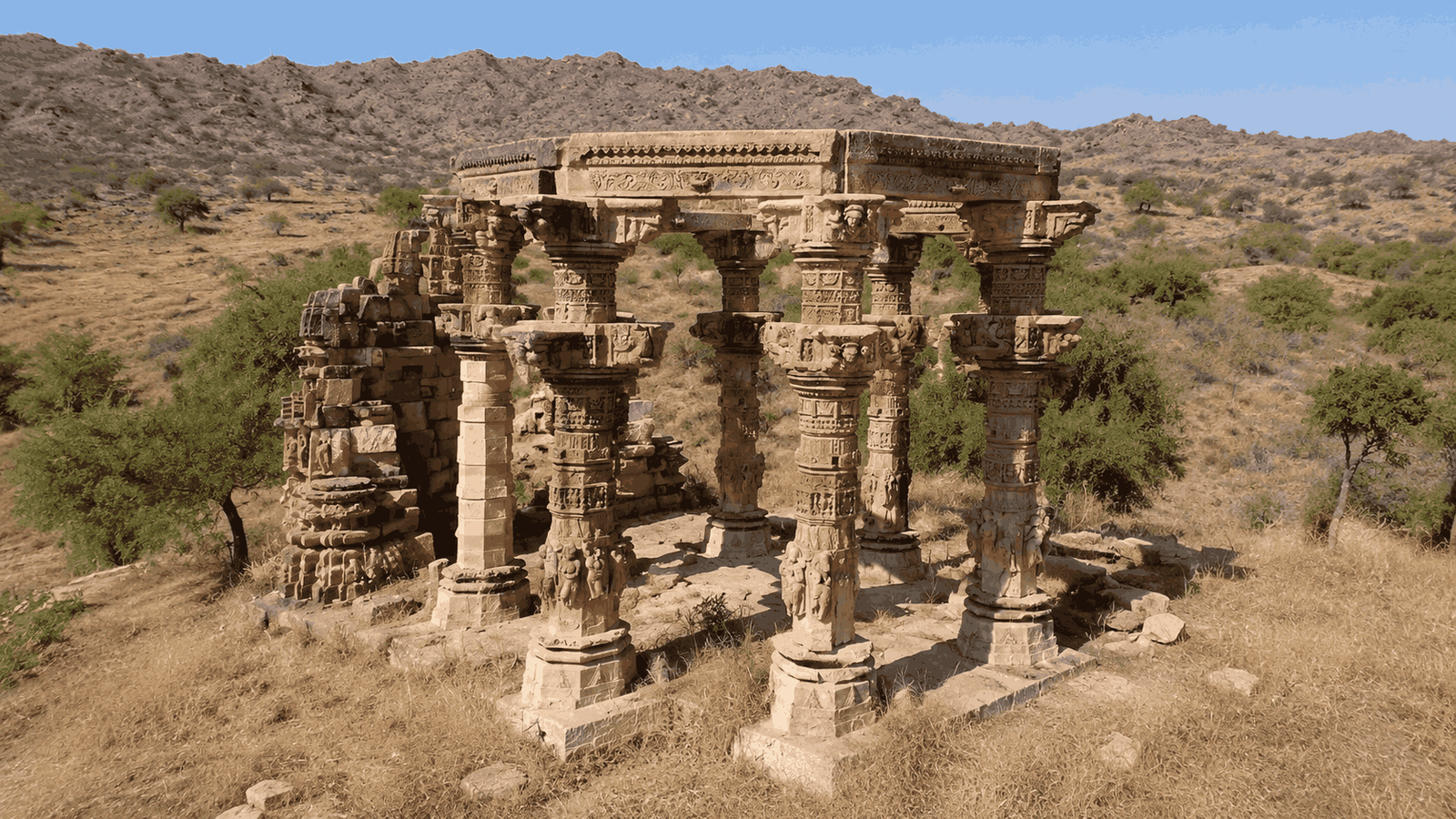
The architecture stands out immediately.
The temples built between the 11th and 12th centuries, under the Parmar/Solanki dynasty, are:
– Intricately carved
– Structurally detailed
– Surprisingly refined for such a remote location
Often compared to the temples of Khajuraho, they follow the Nagara architectural style, with:
– Raised platforms
– Sculpted pillars
– Detailed stonework that has survived centuries
These are not random ruins. They were part of a functioning religious and cultural space.
The Damage That Has Nothing to Do With the Curse
Many of the structures are partially broken.
Carvings are damaged. Figures are incomplete.
This is often linked to the curse in local storytelling.
But historically, the damage aligns with: invasions during the 12th century and attacks by Turkic groups (often referred to as Turushkas)
So the physical condition of the temples has a documented explanation.
The curse explains something else. The emptiness.
Why No One Stays After Sunset
This is where the legend becomes present-day behavior.
Even today, locals avoid staying in Kiradu after dark.
The warning is usually treated more as local belief than as a clearly enforced formal restriction.
But the pattern holds.
People leave before sunset. Consistently.
What Actually Changes After Dark
Kiradu is isolated. That’s the first thing.
Located around 35 km from Barmer, it sits in a part of the desert where:
– There is minimal habitation nearby
– There is almost no artificial lighting
– Sound travels differently
When the sun sets:
– Visibility drops quickly
– The structures lose depth
– Shadows merge into form
The temples, detailed during the day, become silhouettes.
And the silence becomes dominant.
The Psychological Shift
In that kind of environment, the brain reacts differently.
Without:
-Clear visual references
– Consistent sound
– Human presence
It starts filling gaps. Shapes become figures.
Stillness feels like presence. You don’t need the legend for that.
But once the legend is there, it directs the interpretation.
The “Turning to Stone” Idea
This is the part that stands out the most.
And also the part that is most symbolic.
There is no recorded case historical or modern of anyone turning into stone at Kiradu.
What the idea represents is something else:
– Permanence
– Consequence
– Being trapped in place
In a literal sense, the temples themselves are stone.
Still. Unmoving. Preserved.
The story reflects the environment.
Why the Curse Continues to Work
Because no one tests it fully.
People don’t stay.
So there is no counter-story.
No one comes back and says: “Nothing happened.”
The absence of that confirmation allows the belief to continue.
Not because it’s proven. Because it’s unchallenged.
Kiradu in Context
Compared to places like Bhangarh or Kuldhara, Kiradu feels more direct.
There’s no layered narrative.
No multiple versions competing.
Just one idea.
Stay after sunset and something irreversible happens.
That clarity gives the story strength.
Why the Kiradu Temple Curse Feels Different
The Kiradu temple curse feels different because it is not built around a ghost or a hidden presence. It is built around a rule. Leave before sunset. Do not look back. Do not test the place. That simplicity makes the legend easier to remember and harder to dismiss.
Final Thought
So what is the Kiradu Temple curse?
A legend.
A moral story about neglect and consequence.
Attached to a real place with real history and remarkable architecture.
There is no evidence that people turn into stone.
But there is a clear pattern:
– People leave before dark
– The site remains empty at night
– The story continues
And like most places where belief meets environment, the experience doesn’t need proof to remain convincing.
It only needs to remain unanswered.
Read Next:
- Why Every Region Has a Haunted Place
- The Kuldhara Village Curse: Legend, History, and What Remains Today
- The Psychology of Haunted Places: Why Expectation Changes What You Feel
For more articles on paranormal phenomena & haunted places, explore the Legend Hub