
Bhangarh Afternoon Experience: What Changes as You Walk
A Bhangarh afternoon experience is not about sudden scares. It is about how the fort slowly changes as you walk deeper into its ruins, from open daylight to silence, shadow, wildlife, and the pressure of leaving before evening. You don’t enter Bhangarh and feel fear.
Not immediately.
You enter and feel… normal.
And that’s what makes the rest of the experience work.
Because what Bhangarh does, quietly, without announcing it—is shift your perception step by step. By the time you reach the palace, something has changed.
Not in the place.
In you.
Crossing the Threshold: Hanuman Gate
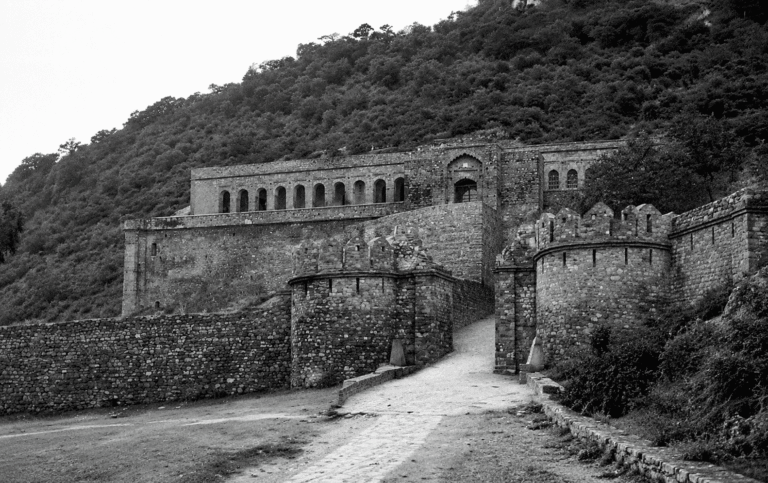
You arrive at the entrance—Hanuman Gate, one of the original entry points into what was once a planned 17th-century Rajput township.
Before anything else, you notice the scale.
And then the trees.
Large banyan trees, old enough to feel like part of the structure itself. Their roots drop down like pillars, blending into stone and earth.
It doesn’t feel abandoned yet. It feels held together.
There are tourists. Some movement. A sense of activity.
But as you walk in, something subtle happens.
Sound drops. Not completely.
Just enough that you notice it.
The First Shift: Sound That Doesn’t Behave Normally
Even in daylight, the air inside Bhangarh feels slightly different.
Voices don’t carry the same way.
Footsteps feel louder than they should.
Background noise disappears faster than expected.
You’re not in silence.
But you’re closer to it than you should be at 2:00 PM.
That’s the first signal.
The Walk Into the Bazaar: Structure Without Life
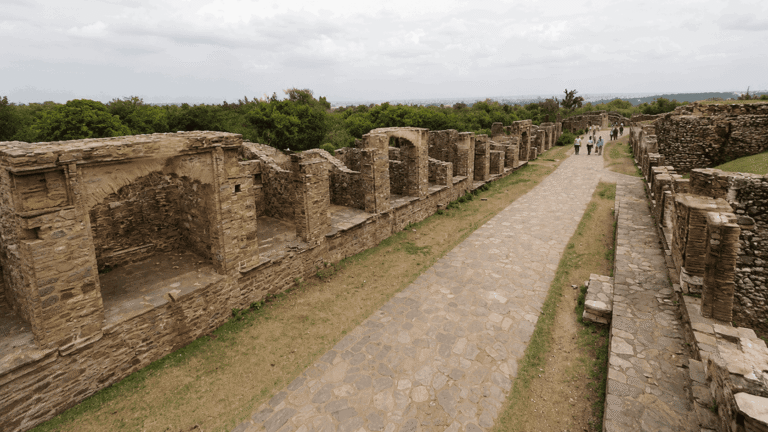
You move forward and enter Jauhari Bazaar.
A long, straight marketplace.
Planned. Symmetrical. Organized.
And completely empty.
Rows of stone shop structures line both sides. Two levels in places. Uniform spacing. Clear design.
And no roofs. Not broken.
Missing.
The “Roofless” Effect
This is where the experience changes.
Because your brain expects:
– Shade
– Enclosure
– Defined space
Instead, you get:
– Exposure
– Repetition
– Open sky above everything
The symmetry makes it more unsettling. It looks like a system.
But a system that stopped working.
There’s a local belief that any roof built here collapses due to a curse.
That belongs to folklore.
The structural reality is simpler, materials decay, especially wood.
But standing there, that explanation doesn’t immediately override the feeling.
Life Inside the Ruins
Just when the emptiness starts settling in, something breaks it.
Movement.
Monkeys.
Wildlife: The Place Is Not Empty
Bhangarh is filled with:
– Rhesus macaques
– Hanuman langurs
– Peacocks
They move freely across walls, structures, and pathways.
You hear:
– Hooting calls
– Rustling
– Distant echoes
The strange part? The place is both empty and active at the same time.
Human absence. Animal presence.
That contrast keeps your brain slightly off-balance.
The Temple Zone: A Momentary Reset
As you continue, you reach the Gopinath Temple.
And everything shifts again.
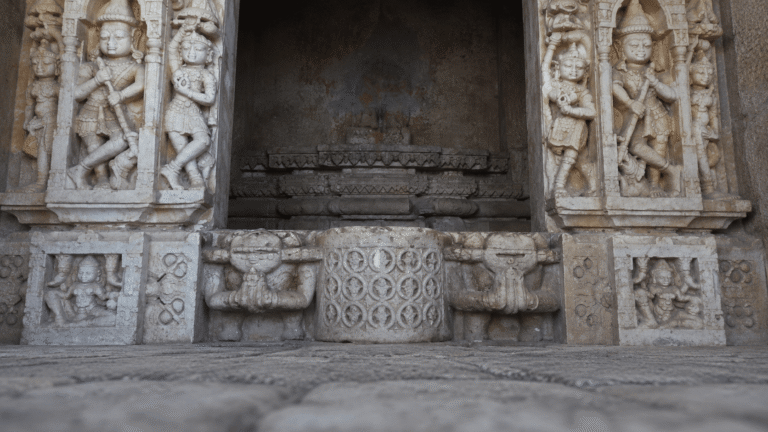
The structure is intact. Detailed carvings. Raised plinth.
Symmetry that still makes sense.
You climb up. Touch the stone. It’s cooler than expected.
The wind picks up slightly here, moving through the carved openings.
For a moment, the place feels… stable.
Almost safe.
Why This Feels Different
Because temples in Bhangarh are better preserved than everything else.
They were built differently.
Stronger materials. More attention. Longer survival.
So when you move from broken residential space into intact temple space, your brain relaxes.
Temporarily.
Moving Toward the Palace: The Pull Begins
Then you leave the temple.
And head toward the back of the complex.
The Royal Palace sits at the far end, against the Aravalli Hills.
From a distance, it looks hollow.
Layered. Incomplete.
The Ascent: Where the Experience Becomes Physical
You approach via a steep ramp.
The ground is uneven. Worn smooth in places.
As you enter the lower sections, the first thing that hits is not visual.
It’s temperature. A sudden drop.
Not refreshing. Dense. Still.
The Smell You Don’t Expect
Then comes the second signal.
A strong, lingering smell.
This comes from bat colonies inside the darker chambers.
It’s heavy. Organic. Persistent.
This is where the experience stops being visual and becomes physical.
Inside the Palace: Space Changes Behavior
Inside the light reduces ,pathways narrow
visibility becomes inconsistent.
Shadows don’t behave predictably.
Openings look deeper than they should.
Your brain works harder to interpret space.
And that increases alertness.
The Upper Levels: Isolation Becomes Obvious
Climb higher. Reach the upper sections.
And then you see it clearly.
The full layout of Bhangarh below you.
The outer walls.
And beyond that, nothing. Just landscape.
the Sariska landscape stretching outward
This is where the scale of isolation becomes real.
Not imagined. Observed.
The Sensation People Talk About
This is also where many visitors report something.
Not dramatic. But noticeable.
Awareness, checking behind them ,sensitivity to movement
Sometimes described as: “feeling watched”
There is no verified external cause for this.
But the environment explains it:
– Incomplete visibility
– Shadow contrast
– Expectation
– Silence
Your brain fills the gap.
The Shift Toward Evening
Around 4:30 PM, something changes again.
The sun dips behind the hills.
And Bhangarh darkens faster than open land.
Shadows stretch. Light becomes uneven.
Contrast increases.
Sound Returns Differently
You begin to hear:
– Peacocks calling
– Distant animal sounds
– Wind moving through structures
But still no human noise. The balance shifts further.
The Exit Begins
Then comes a sharp interruption.
Whistles.
Guards moving through the site.
The signal is clear: Time to leave.
The ASI sunset restriction is enforced strictly .Not casually.
Why They Clear the Site
This is not about ghosts.
It’s about:
– Isolation
– Wildlife movement
– Low visibility
– Structural safety
Wild animals may move through the surrounding region after dark.
The terrain becomes harder to navigate.
So the site is cleared.
The Walk Back Feels Different
On the way in, you walked slowly. On the way out, you walk a little faster.
Not running. But not lingering.
And once you exit the gate and step back into open Rajasthan terrain, something shifts again.
Relief.
Not fear leaving. But pressure lifting.
What the Afternoon Actually Does
So what is a Bhangarh Fort afternoon experience?
Not a haunted encounter.
Not a dramatic event.
It’s a layered shift:
– Normal entry
– Structural curiosity
– Environmental contrast
– Sensory change
– Psychological awareness
– Controlled exit
Each step builds on the previous one.
Final Thought
Bhangarh doesn’t scare you.
It adjusts you. It removes the familiar sound, structure, certainty and replaces it with ambiguity.
By the time you notice the feeling, it’s already there.
Not because something happened.
But because enough small things changed. That is what makes the Bhangarh afternoon experience stay with you not one dramatic incident, but a gradual shift in light, sound, space, and perception.
For official travel context, Bhangarh Fort is also listed by Incredible India as a historic site in Alwar, Rajasthan.
Read Next:
- Bhangarh Expectation vs Reality: What People Actually Feel Inside the Fort
- Bhangarh Fort Experience: What You Notice First Inside the Ruins
- Why Bhangarh Gets So Quiet in the Evening
For more articles on Bhangarh, haunted places, and Indian supernatural legends, explore the Myth Vs Reality Hub