The Question
Out in the desert near Jaisalmer, there’s a place people don’t describe casually.
They call it a ghost village.
A cursed settlement.
A place that was left behind—and never taken back.
That place is Kuldhara.
And like Bhangarh, the story reaches you before the location does.
An entire community disappears overnight.
A powerful official pushes them to the edge.
And before leaving, they curse the land so no one can ever live there again.
That’s the version most people know.
But once you step into Kuldhara, the experience becomes quieter than the story.
And the truth sits somewhere in between.
The Story Everyone Repeats
The legend of Kuldhara is structured clearly.
Too clearly.
In the early 19th century—often placed around 1825—the village was inhabited by Paliwal Brahmins, known for their organized settlements and agricultural knowledge.
According to the story, a powerful local figure—commonly identified as Salam Singh, a Dewan (administrator)—became fixated on marrying a girl from the village.
Not as a proposal.
As a demand.
When the community resisted, the pressure increased:
threats of heavy taxation
abuse of power
no real option to refuse
So the villagers made a decision.
They didn’t negotiate.
They didn’t stay.
They left.
The Overnight Disappearance
This is where the legend sharpens.
It’s said that not just Kuldhara, but 83 nearby villages, were abandoned in a single night.
Homes left intact.
Belongings untouched.
Entire settlements emptied before sunrise.
No signs of struggle.
No recorded resistance.
Just absence.
And before leaving, the story says, the villagers placed a curse:
that no one would ever be able to settle there again.
That’s the part that gives the story its lasting edge.
The Problem With the “Overnight” Version
It’s compelling.
But it’s also simplified.
Because when you look at historical patterns—especially in desert settlements—mass migration rarely happens in a single night.
More often, it’s:
gradual movement
economic pressure
environmental change
political instability
The idea of an overnight disappearance works as a narrative.
It creates impact.
But it doesn’t necessarily reflect how communities actually move.
What likely happened was more complex—and less dramatic than the legend suggests.
What History Suggests
Kuldhara was part of a network of Paliwal Brahmin villages in the region.
These settlements depended on:
water management
agriculture in a harsh environment
stable local governance
When those conditions shift—even slightly—the system becomes fragile.
Possible factors behind the abandonment include:
water scarcity
changing trade routes
taxation pressure
political instability
The Salam Singh story may reflect a real tension.
But it likely became the symbolic explanation for a larger collapse.
Why the Curse Became Central
Because it completes the story.
Without the curse, the narrative becomes:
a village declined and people moved.
With the curse, it becomes:
something happened that should not have happened.
And that changes everything.
The curse turns:
migration into mystery
abandonment into warning
ruins into forbidden space
It also explains why the place remains empty.
Even when the real reasons are practical.
What Kuldhara Looks Like Today
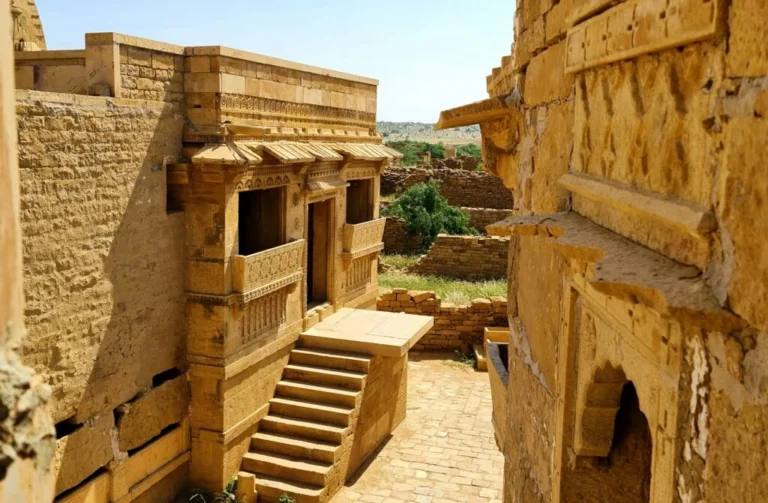
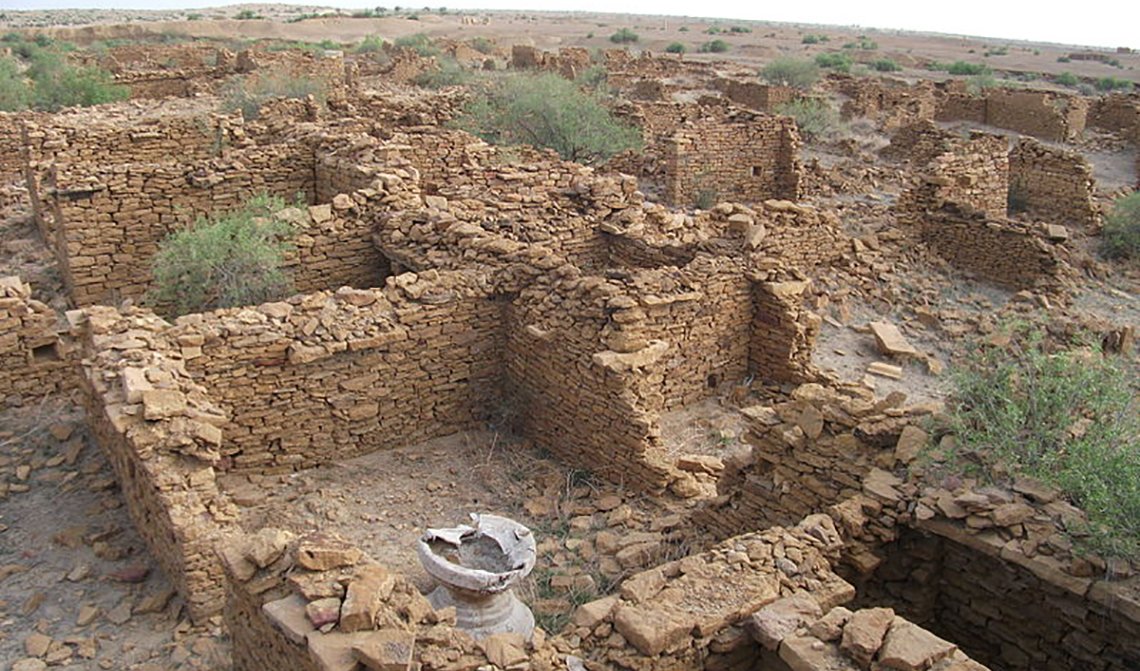
Walk into Kuldhara today, and the first thing you notice is structure.
Not chaos.
Rows of:
stone houses
open courtyards
temple remains
streets that still follow a layout
This was not a random cluster of homes.
It was a planned settlement.
And that’s what makes it striking.
Because the design is still visible.
The life is not.
The Experience Is Not Dramatic
Like Bhangarh, Kuldhara doesn’t overwhelm you.
There’s no sudden fear.
No clear moment where something “happens.”
What you experience instead is:
heat
stillness
open space
silence that stretches further than expected
You walk through structures that were clearly meant to be used.
And now aren’t.
That’s where the unease begins.
Why It Feels Haunted
Not because of visible activity.
Because of absence.
A place built for hundreds—maybe thousands—of people is now empty.
That mismatch creates a specific psychological effect.
Your brain expects:
movement
sound
presence
It gets none.
So it compensates.
That’s where people start to feel:
watched
aware
slightly unsettled
Even when nothing external is happening.
Reports of Paranormal Activity
Like most “haunted” sites, Kuldhara has its share of stories.
Visitors report:
unusual sounds
sensations of presence
discomfort in certain areas
But these are:
inconsistent
unverified
shaped by expectation
There is no confirmed evidence of paranormal activity.
But the environment supports the feeling.
And that’s enough.
Why No One Resettles the Village
This is often attributed directly to the curse.
But the reality is more grounded.
Kuldhara remains uninhabited because:
it is preserved as a heritage site
infrastructure is limited
environmental conditions are harsh
the ruins are protected
The curse explains the outcome.
The practical reasons sustain it.
Kuldhara and Bhangarh — The Same Pattern
Different locations.
Same structure.
Both places combine:
historical abandonment
strong folklore
environmental isolation
psychological impact
That’s why they feel similar.
Not because they share a supernatural origin.
Because they follow a human pattern.
Why the Story Continues
Because it works.
It’s simple.
It’s memorable.
And it explains something that would otherwise feel incomplete.
Without the legend, Kuldhara is a deserted village.
With it, it becomes:
a warning
a mystery
a place people talk about
And once a story reaches that level, it doesn’t fade easily.
Final Thought
So what is the truth about Kuldhara?
A real village.
A real decline.
A likely migration.
And a powerful story built around it.
The legend gives you a clear explanation.
The place gives you something less defined.
And like Bhangarh, it’s that gap—between what is told and what is experienced—that keeps people coming back to it.
Read Next:
- Why Every Region Has a Haunted Place
- The Legend of Bhangarh vs What People Actually Experience
- The Real Story of Bhangarh Fort: History, Decline, and How It Became Famous
- Why Bhangarh Feels Haunted (Reality Explained)
- The Curse of Bhangarh: How the Legend Began and Why It Endures
Or explore the full story behind Bhangarh on the main hub page.