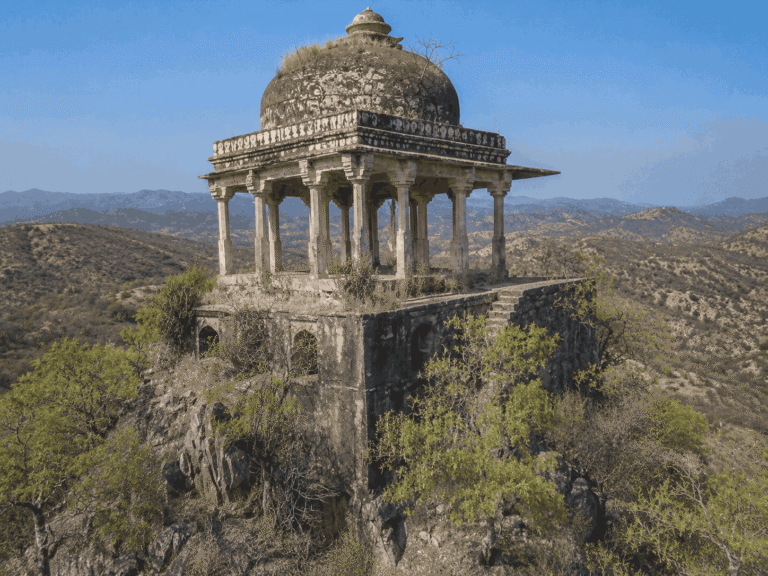

There is another Bhangarh legend that does not begin with black magic, romance, or revenge.
The Guru Balu Nath Bhangarh story is one of the quieter legends attached to the fort, but it carries one of the clearest warnings in its folklore. Most people know the Bhangarh legend through the tantrik story.
But there is another version.
No obsession. No black magic ritual. No love story.
Just a warning. And a mistake.
According to this lesser-discussed legend, Bhangarh’s fall began with a sage named Guru Balu Nath.
The Condition That Made the Fort Possible
As the legend goes, when Raja Bhagwant Das decided to establish Bhangarh in the late 16th century, he encountered the sage. Construction could not proceed without his consent.
And consent came with a condition. In the Guru Balu Nath Bhangarh version, this condition becomes the moral center of the entire curse.A simple one, at least on the surface:
The shadow of the palace must never fall upon the sage’s meditation site.
That was it. No demand for land. No demand for wealth. No demand for authority.
Just distance. Not physical distance but symbolic.
The kingdom could exist. But it could not overshadow the place of meditation.
Why the Condtion Matters
At first glance, it feels almost arbitrary. Why would a shadow matter?
But in traditional storytelling, especially in folklore rooted in ascetic traditions, such conditions are rarely literal alone.
They represent: respect for spiritual space, boundaries between power and renunciation, the idea that worldly ambition must not dominate sacred ground.
So the condition was not just about light and shadow. It was about restraint.
The City Rises Anyway
And for a time, the condition holds.
Bhangarh grows. Structures are built within limits.
The palace stands but not high enough to cast a shadow over the sage’s retreat.
Life continues. The kingdom functions. Nothing unusual happens.
That’s important.
Because it shows that in this version of the story, Bhangarh is not immediately doomed.
The downfall comes later.
The Disobedience
Unlike the more dramatic tantrik version, the Guru Balu Nath Bhangarh story is built around restraint, obedience, and the consequences of ignoring a condition. This is where versions begin to diverge slightly.
But the core remains consistent.
At some point after the original construction often attributed in certain retellings to a later ruler, sometimes named Ajab Singh, son of Chhatra Singh the palace is expanded.
Higher levels are added. The structure rises beyond its original limit.
And eventually, the condition is broken.
The shadow falls.
The Moment Everything Changes
There is no dramatic buildup in this version.
No confrontation scene. No warning repeated.
Just the violation.
The shadow symbolic or literal reaches the sage’s dwelling.
And that is enough.
The Curse of Guru Balu Nath
According to the legend, Guru Balu Nath, angered by the broken promise, curses the city.
The wording varies, as it does in most oral traditions, but the essence remains:
– Bhangarh will not survive.
– The city will fall.
– Its prosperity will end.
And from that point onward, its fate is sealed. Some versions describe the destruction as immediate.
Others imply a rapid decline soon after.
But all agree on one thing: The curse follows the disobedience.That is why the Guru Balu Nath Bhangarh legend feels less like a ghost story and more like a warning about power crossing a sacred boundary.
What This Story Suggests, Beyond the Surface
Unlike the Ratnavati–Singhia legend, this version is not driven by desire or revenge.
It is driven by violation.
Not of a person. But of a principle.
The moral structure is different:
– A boundary is set
– A promise is made
– Power ignores restraint
– Consequence follows
That makes this legend feel less like a supernatural attack and more like a moral correction.
Is This the Real Reason Bhangarh Was Destroyed?
No.
There is no verified historical evidence that Guru Balu Nath’s curse caused the fall of Bhangarh. Like other stories associated with the fort, this narrative exists within folklore, not documented history.
Historical explanations for Bhangarh’s decline point toward:
– Political shifts
– Environmental conditions
– Changing regional dynamics
But those explanations are complex and gradual. This story is simple. And that’s why it survives.
Why This Legend Is Less Popular, But Still Powerful
The Ratnavati–Singhia story is more dramatic.
It has:
– Romance
– Betrayal
– Black magic
i-Immediate consequence
This story is quieter. It requires interpretation. But in some ways, it is more unsettling.
Because it suggests that Bhangarh didn’t fall because of a single emotional act. It fell because someone ignored a limit they were not supposed to cross. That feels more universal.
Multiple Legends, One Ruin
This is where things become interesting.
Bhangarh does not have one explanation for its fall.
It has several:
– A cursed love story
– A tantrik’s revenge
– A sage’s warning ignored
These stories don’t fully align. They overlap, contradict, and evolve.
Which raises a different question: Why does one place need multiple legends to explain it?
Because the real history is not clean. And when history leaves gaps, stories compete to fill them.
Final Thought
So what is the Guru Balu Nath Bhangarh story really about?
It is the legend of a sage who allowed a kingdom to rise with one condition and a ruler who, knowingly or not, broke that condition.
It is a story where the downfall of a city is not caused by magic alone, but by disregard and like all Bhangarh legends, it exists not as confirmed history but as a way of making sense of what remains.
Because when people stand in those ruins and ask: “What brought all of this down?”
They don’t just want an answer. They want a reason.
And sometimes, the simplest reason is the one that stays: Someone was warned.
And they didn’t listen.
Read Next:
- Bhangarh Curse Explained: Ratnavati, Singhia, and the Legend
- Who Was Rani Ratnavati of Bhangarh?
- Tantrik of Bhangarh: The Story of Singhia and the Curse
For more articles on Bhangarh, haunted places, and Indian supernatural legends, explore the Legends hub.